
TL;DR
- LinkedIn isn't expensive, vague campaigns are. A €180 CPL is almost always an offer/segmentation problem, not a platform problem.
- The lead magnet moves CPL more than the audience or the bid: Document Ads land €15–€100, Lead Gen Forms €15–€50, purely on asset quality.
- Keep audiences between 50k and 500k. Below 50k saturates; above 500k means your ICP is still lazy.
- Don't optimise a funnel that doesn't exist yet. Early on, put the whole budget on ICP-defined cold prospecting.
- Stop reporting gross CPL. A €25 CPL at 5% MQL is worse than €80 at 40%. Pipeline generated is the only metric that ends the argument.
I've lost count of how many B2B SaaS founders have told me, almost proudly, that "LinkedIn doesn't work". Usually they show me an account with a €180 CPL and a pipeline that hasn't moved in two weeks, and the conclusion is always the same: LinkedIn is too expensive.
It almost never is.
The problem is almost never the platform. The problem is expecting a distribution channel to do the work that the content, the offer and the segmentation should be doing.
LinkedIn Ads doesn't generate pipeline on its own. Pipeline is generated by what you put in front of the user: the message, the asset, the perceived value and how well your proposition fits their problem. LinkedIn does one thing, it distributes that content to the right people and optimises who sees it.
Here's the full playbook I actually use to turn a "LinkedIn doesn't work" account around. It’s the same used by Manglai, where we managed to move the pipeline thanks to paid in lead quantity, lower costs per lead and better quality (more qualification). So you can get an idea of what Manglai is, it’s a SaaS B2B created to measure, analyze and optimize the carbon and waste footprint of companies. It’s a pretty small niche since only enterprise and mid-market companies are the ones that have to use it and they usually have a lot of pains.
Why is LinkedIn still the best channel for B2B SaaS?
Meta and Google usually have cheaper clicks. LinkedIn has something more important: professional precision. It's the only platform where you can combine in a single audience:
- Job title
- Seniority
- Company size
- Industry
- Years of experience
- Professional skills
In B2B SaaS you're usually trying to reach a very specific person inside a very specific company. That level of precision changes spending efficiency completely.
According to platform data, more than 80% of B2B leads from social media are generated on LinkedIn.
That said: LinkedIn punishes vague campaigns hard. Audiences are expensive. Every impression has to justify its cost. That's why everything starts with the ICP.
How do you define an ICP you can actually use in Campaign Manager?
In LinkedIn Ads an ICP is not a theoretical document. It's a segmentation system. It has to be actionable inside Campaign Manager.
When the ICP is vague, the segmentation is too. And when the segmentation is vague, leads come out expensive and poorly qualified.
Layer 1: Company fit
First define what type of company makes sense as a client.
Industry: Avoid broad buckets like "Technology". Specific segmentations, SaaS, fintech, HR tech, martech, B2B software, are far more useful.
Company size: For many SaaS products the sweet spot sits between 50 and 500 employees. Big enough to have budget, small enough to decide relatively fast.
Geography: Start with your main market and expand once you have clear references on CPL, MQL and pipeline.
Layer 2: Person fit
Here you define who inside the company should see the ad.
Role and function: Combine job-function filters, specific titles and seniority. Example: Head of Marketing, Marketing Director, VP Marketing.
Years of experience: An underused but very useful filter. It lets you cut profiles that are too junior or too senior.
Skills: In technical audiences like RevOps, Marketing Ops, Data, BI or CRM, skills tend to work particularly well.
The real problem: you're selling to a committee
In B2B SaaS a single person rarely decides. A purchase typically involves:
- Economic buyer (CFO / VP Finance)
- Internal champion (Marketing Director / Head of Demand Gen)
- Technical influencer (RevOps / Ops Manager)
That's why it makes sense to adapt the message by role. The algorithm doesn't need a rigid funnel, but it does need clear inputs: which message works with which profile.
The right audience size
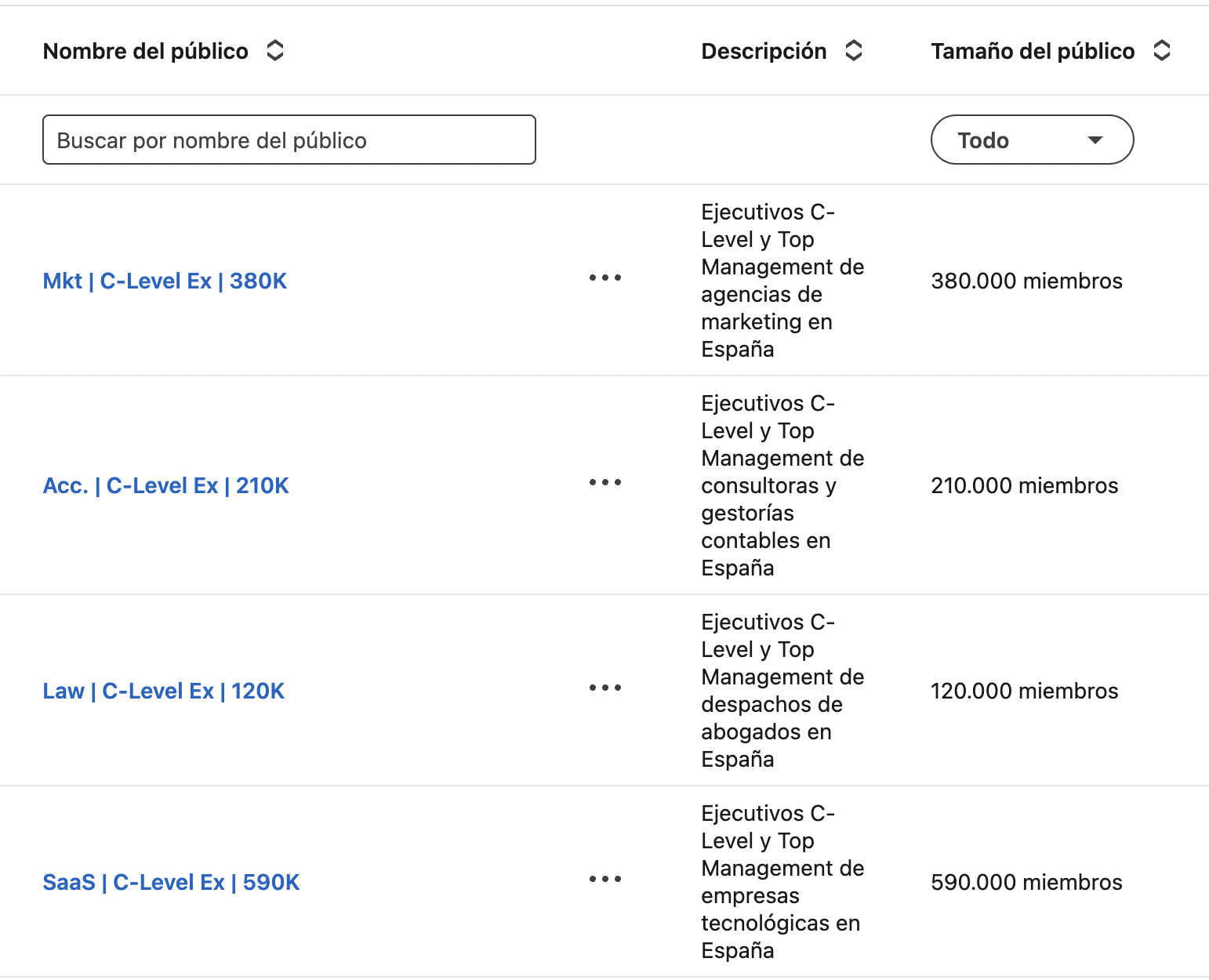
LinkedIn recommends audiences between 50,000 and 500,000 users, usually the best balance between reach and precision. Below 50,000 the audience is too small: fast saturation, high frequency, limited algorithm learning. Above 500,000 it's too broad, which just means the ICP can be refined further.
How should you structure campaigns for today's algorithm?
For years accounts were structured following the TOFU / MOFU / BOFU model. Still useful as a mental frame, but current algorithms don't need you to manually segment every funnel phase. What they need is: good audiences, good creatives, good conversion signals.
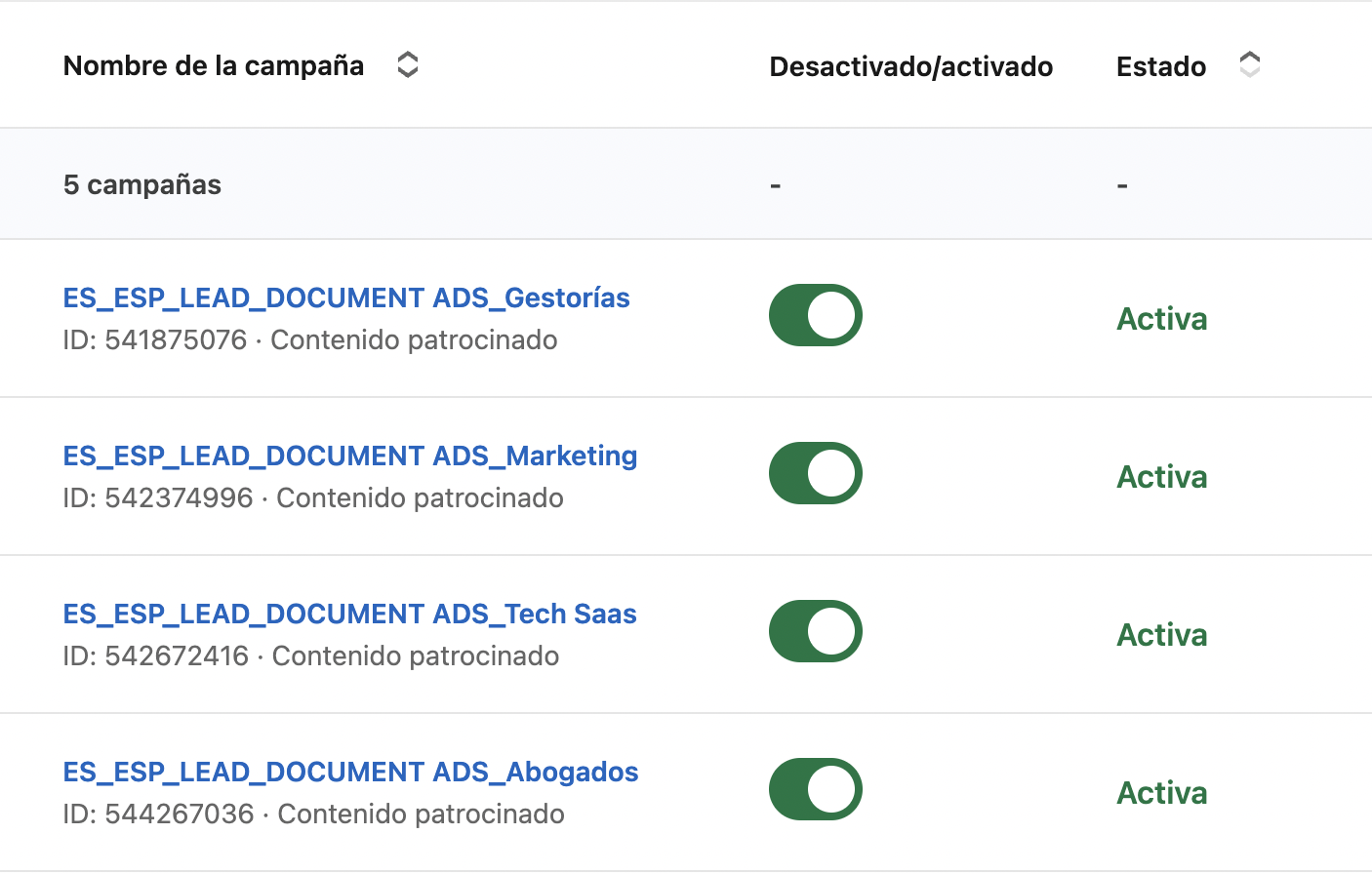
A more useful structure organises by Country_Language_Objective_Format_ICP:
- ES_ESP_Lead_Document Ads_Agencies
- ES_ESP_Awareness_Thought Leader Ads_SaaS
- EN_UK_Lead_Lead Form_Marketing Agencies
This lets you see fast what works by person, asset and audience.
Where should your budget go when you're starting?
When a B2B SaaS company starts investing in LinkedIn Ads it usually has one clear problem: not enough pipeline or brand awareness. Trying to optimise remarketing when almost nobody knows your product doesn't work, there isn't enough warm audience volume.
That's why, in the early stages, the most logical strategy is to concentrate the budget on qualified prospecting: cold audiences well defined by ICP combined with high-value creatives and assets.
The goal at this stage isn't to optimise an existing funnel. It's to build it from scratch. Over time those signals generate new audiences: website visitors, users who engaged with ads, people who opened forms, previously captured leads. That ecosystem lets you build remarketing and high-intent campaigns later. At the start it doesn't exist yet.
First you build the market. Then you optimise the funnel.
Which lead magnets actually lower CPL?
In LinkedIn Ads one of the variables that most determines performance is the lead magnet. The faster the user perceives the value, the more likely they share their details.
Document Ads generate CPLs between €15 and €100 depending solely on the quality of the lead magnet. Not the audience. Not the bid. The asset.
In almost all my clients, guides, e-books ands playbooks have been the top 1 winners. In the case of Manglai, we use the “Guide on Spanish Sustainability Law for 2026” lead magnet. This is the one that has worked the best by far (20€ CPL vs 40€-60€ CPL for the rest).
Calculators and simulators
Simulations or calculators tend to be among the most powerful lead magnets. They let the user enter information to estimate ROI, savings, market benchmarks, or cost and efficiency impact. A very effective structure: let the user complete the whole simulation and show the final result behind a form. Someone who's invested time filling in a calculator has much higher intent than someone downloading a generic guide.
Guides and e-books with preview access
LinkedIn's Document Ads work particularly well because they let users consume part of the content before asking for their details. The user views several pages. Those pages show real value. The rest is locked behind the form. This beats locking everything from the start because the user has already judged the content quality, in practice the document itself becomes the ad creative.
Concrete lead magnet examples

This guide explains in 28 pages how the new environmental regulatory framework in Spain and Europe will impact companies from 2026. It covers the main laws, directives and standards and what obligations companies will have on carbon-footprint calculation, reporting and emission-reduction plans.

This checklist helps CTOs, CFOs and founders of tech companies evaluate whether their cyber insurance policy actually covers the risks of a SaaS company. It analyses key coverages like downtime, data breaches, software supply-chain attacks and SLA penalties.

The bare-ownership calculator is a good example of an immediate-value lead magnet. The user enters basic information about their property and gets an estimate of the money they could receive by selling the bare ownership while continuing to live in the home.
Which ad formats work best for B2B SaaS?
Document Ads
One of the most effective formats for B2B SaaS. Advantages: content preview, better lead quality, and the content acts as the creative. Best practices: show value in the first pages, 8–15 pages, clear visual cover, content specific to a defined audience.
Lead Gen Forms
Native forms generate more volume because they cut friction. No landing page, no redirect, everything happens inside LinkedIn.
Lead Gen Forms generate CPLs between €15 and €50, although lead quality is generally lower than Document Ads. Use both in parallel and measure which asset generates better pipeline.
They work especially well when you need fast volume, have good downstream scoring and sales can respond quickly.
How should you think about creative?
One of the biggest mistakes in LinkedIn Ads is using the same type of creative for everything. Cold audiences respond better to relevant content than to corporate creative: posts with insights, counter-intuitive data, short videos with a point of view, creatives with a personal tone. Once the audience has engaged with you, you can be more direct: documents, reports, calculators, audits, demos. With high-intent audiences, social proof carries a lot of weight: client logos, concrete results, success stories.
Which audiences and signals are most underrated?
Beyond the initial ICP, LinkedIn lets you build audiences from behaviour: website visitors, video viewers, people who engaged with ads, users who opened forms, document downloads.
Particularly valuable is the audience of people who opened a form but didn't submit it. That behaviour usually signals quite strong intent and is one of the most underrated audiences on the platform.
Which metrics actually matter (and which mislead you)?
Optimising LinkedIn Ads by looking only at CPL leads to wrong decisions.
Cost per MQL
More relevant than gross CPL. A €25 CPL with a 5% MQL rate is worse than an €80 CPL with a 40% rate.
MQL → SQL
Tells you whether the leads reaching sales are genuinely valid. If this ratio is low, the leads are usually too cold or the audience isn't right.
Pipeline generated
The metric that really matters. It connects LinkedIn Ads spend with real business impact, not just leads acquired and qualified, but revenue generated from the campaigns.
What do most B2B SaaS teams get wrong on LinkedIn Ads?
This is the part nobody likes to hear, so I'll just say it:
- They blame the channel for an offer problem. "LinkedIn is expensive" is almost always "my lead magnet is a 4-page PDF nobody wants". The €180 CPL is a symptom, not a diagnosis.
- They copy the TOFU/MOFU/BOFU diagram into Campaign Manager. The funnel is a way to think, not a campaign structure. Splitting micro-budgets across five funnel stages starves the algorithm of signal.
- They optimise CPL and report CPL. It's the easiest number to move and the least connected to revenue. You can halve CPL and halve pipeline at the same time.
- They expect remarketing to save a cold account. There's nothing to remarket to yet. More than once I’ve stumbled on companies that have a prospecting campaign active at the same time as a remarketing campaign with just 200€ /
If you fix only one of these, fix the offer. Everything else is downstream of the asset.
So where do you start?
LinkedIn Ads can be one of the most powerful pipeline channels in B2B SaaS, but not on its own. It doesn't reward whoever organises campaigns most neatly around a theoretical funnel. It rewards whoever gives the algorithm the best inputs: a clear ICP, properly sized audiences, a lead magnet that delivers immediate value, relevant creatives, clean conversion signals.
The first goal isn't to optimise the funnel. The first goal is to build it.
So start with the asset. Build something your ICP actually wants to consume, then use LinkedIn to put it in front of the right people. Everything in this playbook is downstream of that one decision.
What's the worst LinkedIn CPL you've seen, and was it really the platform's fault? I'd genuinely like to know.
Do you need help turning LinkedIn Ads into a real pipeline channel for your B2B SaaS? At FerrerPonseti we build acquisition systems around the offer and the data, not just the campaigns. Let's talk.
FAQ
How much does a LinkedIn Ads lead cost for B2B SaaS?
Document Ads typically land between €15 and €100 per lead and Lead Gen Forms between €15 and €50, driven mostly by lead-magnet quality, not bid or audience. A €180 CPL usually signals an offer or segmentation problem.
How big should a LinkedIn Ads audience be?
Between 50,000 and 500,000 users. Below 50k it saturates fast; above 500k your ICP is probably still too broad.
Should I start with prospecting or remarketing?
Prospecting. Early on there's no warm audience to remarket to, concentrate budget on ICP-defined cold audiences and let the signals build the remarketing pool over time.
Document Ads or Lead Gen Forms?
Run both. Lead Gen Forms give volume and lower friction; Document Ads give higher-quality leads because the content is consumed before the form. Measure which one generates better pipeline, not better CPL.
Why is my LinkedIn CPL so high?
Almost always the lead magnet or the segmentation, not the platform. A generic "download our guide" against a vague audience produces expensive, poorly qualified leads.
Which metric should I optimise for?
Pipeline generated, then cost per MQL and MQL→SQL. Gross CPL is the easiest number to move and the least connected to revenue.